Why are progressive lenses so expensive? A Phoenix optician explains
Why progressive lenses cost more than single vision: the lens design, freeform surfacing, precise fitting and lab work, and where to spend or save.
Progressive lenses cost more than single-vision lenses because each one holds three prescriptions in a single piece of plastic, blended without a visible line, and that blend has to be designed, surfaced and fitted to your eyes within a millimeter or two. You are paying for the lens design, the manufacturing, the coatings and the time it takes an optician to measure and adjust them properly. It is one of the questions we hear most at our counter at Biltmore Plaza, so here is the honest answer.
Why are progressive lenses so expensive?
Progressive lenses are expensive because they are the most complicated everyday lens an optical shop makes. A single-vision lens has one power across the whole surface. A progressive starts with your distance prescription at the top, adds power gradually through a narrow corridor for middle distance, and reaches your full reading power near the bottom. The ADD number on your prescription tells us how much extra power you need for reading.
Making that change in power smooth, with no line, takes real optical engineering. Somewhere the math has to give, and it gives at the sides of the lens, where you get the soft, slightly swimmy areas people notice in their first week. Much of what you pay for in a better progressive is a design that keeps those areas smaller and the clear zones wider.
Then there is the part nobody sees: the fitting. A progressive that is a couple of millimeters too high or too low feels wrong no matter how good the lens is. The time an experienced optician spends getting that right is part of the cost, and in our view it is the part most worth paying for.
What goes into the lens itself
When people ask why one progressive costs more than another, the difference usually comes from a few places:
- The design. Lens makers like ZEISS invest heavily in developing progressive designs. Basic designs have narrower corridors and more blur at the edges. Premium designs widen the reading and middle zones and soften the transitions.
- Freeform surfacing. A traditional progressive is mass-produced with a fixed design. A ZEISS freeform progressive is surfaced point by point for your prescription, and better designs also use your frame and fitting measurements. The equipment and processing behind that are a big step up from a stock lens.
- The material. Stronger prescriptions often call for high-index material to keep lenses thinner and lighter. That costs more than standard plastic, and with progressives it also helps the lens sit better in a fashionable frame.
- The coatings. Anti-reflective, scratch-resistant and UV coatings are applied in layers. Light-adaptive options like ZEISS PhotoFusion X darken in the sun and clear indoors, which is handy in Phoenix where you go from a bright parking lot to a dim restaurant several times a day.
What goes into the fitting
A progressive lens is only as good as its placement. For every pair, we measure each eye's pupillary distance separately, the fitting height in the frame you will actually wear, and how the frame tilts and wraps around your face. With freeform lenses, those numbers go into the lens design itself.
Before any of that, Vince adjusts the frame so it sits the way it will sit every day. Measuring a frame that is crooked or sliding down your nose produces lenses that are crooked or too low. It sounds fussy. It is fussy. That is the job.
Then there is the follow-up. Most people settle into new progressives within a few days to two weeks, and small adjustments along the way make a real difference. If something feels off, we want you back in the chair. Our post on blurry progressive lenses covers the most common culprits, and almost all of them trace back to fit rather than the lens.
Are cheaper progressives worth it?
Sometimes, but usually less often than people hope. We see this every week: someone brings in a bargain pair of progressives they have never gotten used to, and the problem turns out to be measurements taken quickly, a basic design that is too narrow for how they live, or both. They end up buying glasses twice, which is the most expensive way to buy progressives.
A few honest guidelines from behind the counter:
- If you read a lot or work at a screen, a wider design is worth it. Narrow reading zones are among the most common complaints we hear.
- If your ADD power is low and you are new to progressives, a mid-range design can work well, as long as the fitting is right.
- If you mostly need help up close, you may not need progressives at all. Single-vision readers or an office lens can be a simpler choice, and we will tell you if that is the case.
- If you have a strong or complex prescription, this is where premium designs and careful fitting earn their keep.
We would rather talk you out of something you do not need than sell you a lens you will not wear.
How to get more for your money
The best value in progressives comes from matching the lens to your day. If you spend hours at a computer, a second pair built for desk work may serve you better than paying for the top design in one pair that has to do everything. If you drive a lot or golf, progressive sunglasses mean you can read your phone in the car and still see the road. Our progressive lenses page lays out the main options.
The calendar matters too. Prescription eyewear is generally an eligible FSA and HSA expense, and many plans have a year-end deadline, so check yours. We covered that in our post on using FSA and HSA funds for glasses. Winter visitors arriving in Paradise Valley, Scottsdale or Arcadia for the season can get a new pair started early in their stay, since progressives take longer than simple lenses to make. Our on-site lab handles finishing and adjustments here at the shop, and we will give you a realistic timeline when you order.
One note on your eyes, not your glasses: getting used to progressives is gradual and mild. Sudden changes in vision, flashes of light, a shower of new floaters or eye pain are not a lens problem. See an eye doctor promptly.
Talk it through with us at Biltmore Plaza
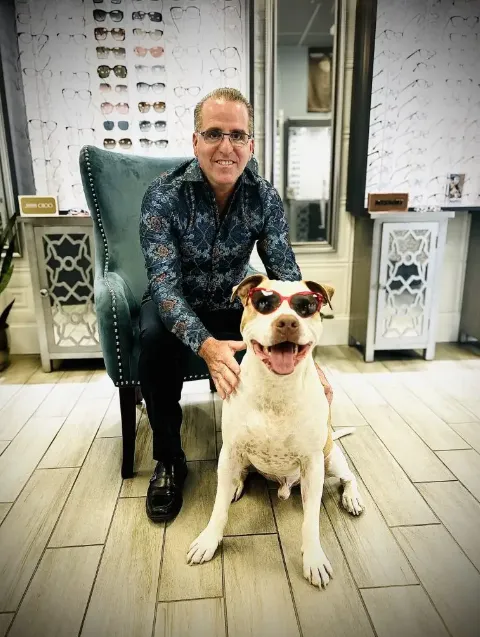
We are opticians, not optometrists, so bring a current prescription from any eye doctor and we will take it from there. Walk in any time we are open: Monday through Thursday 10am to 5:30pm, Friday 10am to 5pm and Saturday 9am to noon. We are at 3126 E Camelback Rd in Phoenix, at the northwest corner of Biltmore Plaza next to Safeway, with free parking. Dogs are welcome, and they tend to get more attention than the frames.
Want a sense of what your prescription calls for before you come in? Text a photo of it to (602) 799-1345, and we will walk you through the options in plain English.