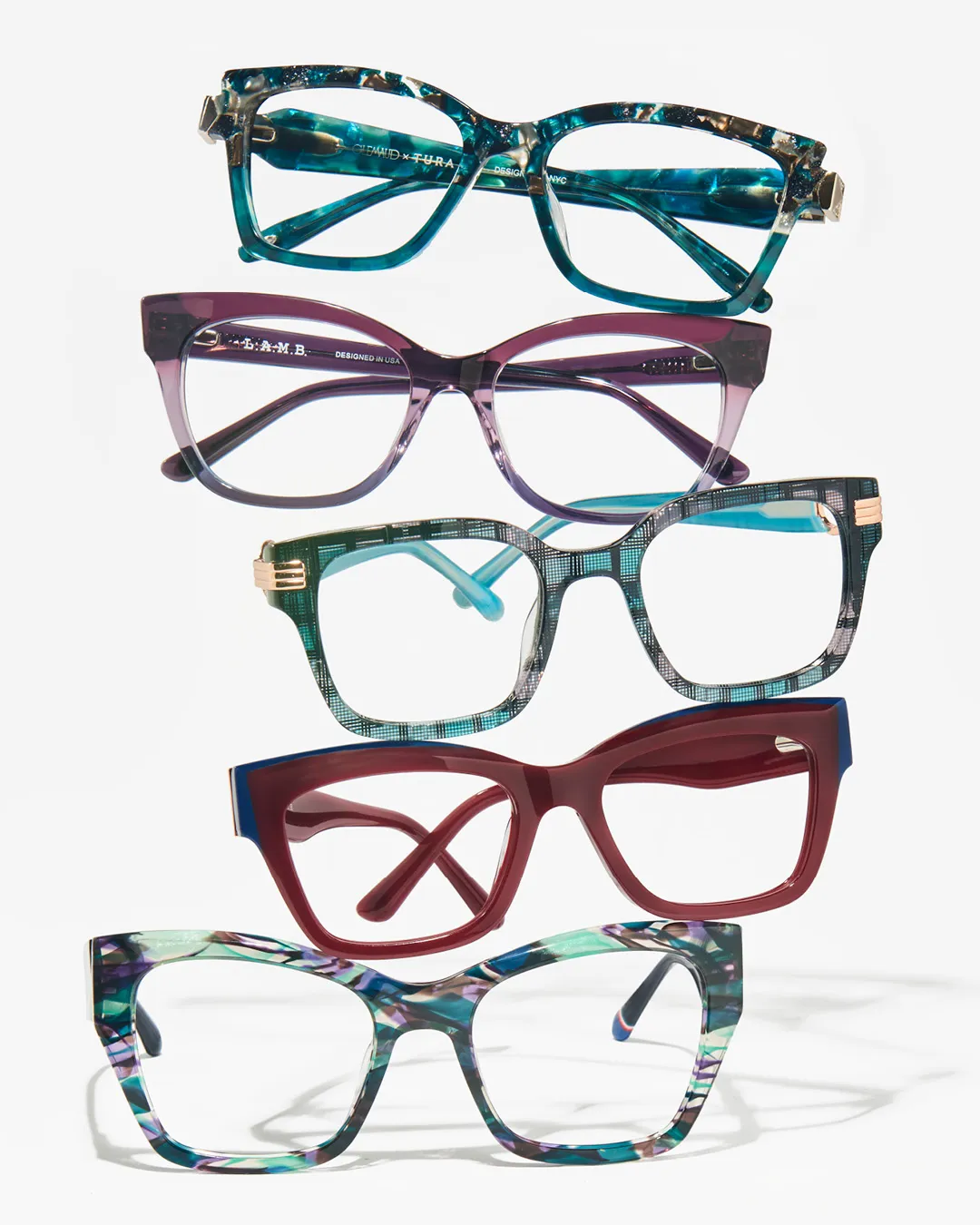
What is astigmatism? A plain-English guide from Biltmore opticians
What is astigmatism, and what do CYL and AXIS mean on your prescription? Biltmore opticians in Phoenix explain it in plain English, and how lenses fix it.
Astigmatism means the front of your eye, usually the cornea, is curved more like a football than a basketball, so light focuses at two different points instead of one. The result is vision that can look blurry, stretched or shadowed at any distance. It is very common, it is not a disease, and in most cases a well-made pair of glasses corrects it clearly.
What is astigmatism, in plain English?
Astigmatism is a focusing error caused by an eye that is curved more steeply in one direction than the other. Picture the back of a spoon compared with a marble. A marble curves evenly every way you turn it. A spoon curves more along one direction. When the cornea or the lens inside the eye has that uneven shape, light entering the eye is bent by different amounts depending on its angle, and it cannot all land on the same spot.
Many people with astigmatism also have some nearsightedness or farsightedness, and the two are corrected together in the same lens. The National Eye Institute has a good overview if you want the medical side. Our side of the counter is what happens next: turning that prescription into glasses that actually feel right.
What does astigmatism feel like?
We hear the same descriptions every week here at Biltmore Plaza:
- Letters that look smeared or doubled, especially on menus, street signs and the small print on a pill bottle.
- Headlights and streetlights with streaks or starbursts at night. Plenty of people first notice it driving home on Camelback Road after dark.
- Squinting and tired eyes at the end of a long day of reading or screen work.
- Blur at every distance, not just far away or up close.
These descriptions are not a substitute for an eye exam, which is the only way to know what is going on, and we are opticians, not optometrists, so we do not do exams. If your vision changes suddenly, or you notice flashes of light, a shower of new floaters or eye pain, see an eye doctor promptly. That is not a glasses question.
How astigmatism shows up on your prescription
If you have your eye doctor's prescription handy, look for three columns for each eye:
- SPH (sphere) is the overall nearsighted or farsighted correction.
- CYL (cylinder) is the amount of astigmatism correction. If this box is blank, there is no astigmatism to correct. The bigger the number, the more there is.
- AXIS is a number from 1 to 180 that tells us the direction of the astigmatism, in degrees. Think of it as the angle on a protractor laid across your eye. An axis of 90 points straight up and down, and 180 runs side to side.
One thing that trips people up: some doctors write cylinder as a minus number and others as a plus number. Two prescriptions can look completely different on paper and describe exactly the same correction. Before you worry that your new prescription is wildly different from your old one, text us a photo and we will translate.
Why the axis matters so much in the lab
Here is where astigmatism gets interesting for an optician. A lens that corrects astigmatism has a strong direction and a weak direction, and it only works when those line up with your eye. If the axis is off by a few degrees, the correction is pointed slightly the wrong way, and the eye notices. With a small cylinder, a little error is forgiving. With a larger one, a few degrees can be the difference between crisp and "something is off but I cannot say what."
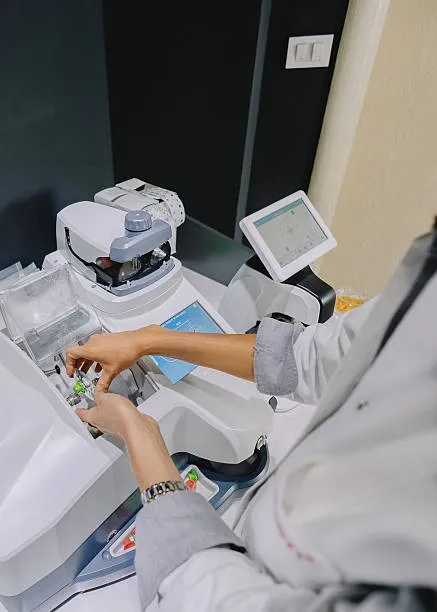
That is why careful axis alignment is a big part of our complex prescriptions work. In our on-site lab, Tara marks and checks the axis before the lens is edged to fit your frame, then verifies the finished lens against your prescription. Vince then adjusts the frame so it sits level on your face. A crooked frame tilts the axis right along with it, which is one reason a pair that was made correctly can still look slightly wrong until it is adjusted. We wrote more about the numbers we take in what an optician actually measures.
On timing: we keep readers and spherical single-vision lenses in stock, and single-vision lenses with astigmatism are usually ready in 1 to 2 business days, holidays excluded. Progressives and specialty lenses take longer, and we will give you a realistic estimate when you order.
Astigmatism and progressive lenses
Astigmatism is no barrier to progressives. Your cylinder and axis are built into the lens along with your distance and reading powers. That said, a strong astigmatism correction is exactly where lens design starts to matter. A freeform design, like the ZEISS progressives we explained in our freeform guide, calculates the whole surface for your specific numbers instead of stretching a stock design to fit. For people with more astigmatism, that often means a cleaner reading area and less of the soft blur at the sides. Our progressive lenses page walks through the options.
Getting used to a new astigmatism correction
If your cylinder or axis changed, or you are correcting astigmatism for the first time, your new glasses may feel a little strange at first. Floors can seem to slope, doorways can look tilted, and the world may look a touch taller or narrower than you remember. Your brain spent years adapting to the old blur, and it takes a few days to adapt to the clear version. It is about the only time we hear people complain that the world looks too sharp.
Wear the new pair full time rather than switching back and forth. If things still feel off after a week or so, come back in. Sometimes the frame needs a small adjustment, and sometimes we will check the lenses against the prescription and suggest a call to your eye doctor.
A few frame tips if you have astigmatism
- Choose a frame that stays put. A pair that slides down your nose changes how the lens lines up with your eye.
- Stronger cylinders like smaller lenses. A moderate lens size keeps edges thinner and distortion lower. Our guide to high-index lenses covers thinner materials.
- Sunglasses count too. Polarized prescription sunglasses can carry your full astigmatism correction, which helps on bright Arcadia and Paradise Valley afternoons.
Bring your prescription to Biltmore Plaza
Bring a current prescription from any eye doctor, and we will help you choose a frame, take the measurements and make lenses that line up the way they should. Walk in any time we are open: Monday through Thursday 10am to 5:30pm, Friday 10am to 5pm and Saturday 9am to noon. We are at 3126 E Camelback Rd, at the northwest corner of Biltmore Plaza next to Safeway, with free parking. Dogs are welcome, as always.
Not sure what your CYL and AXIS mean? Text a photo of your prescription to (602) 799-1345, and we will explain it in plain English.